
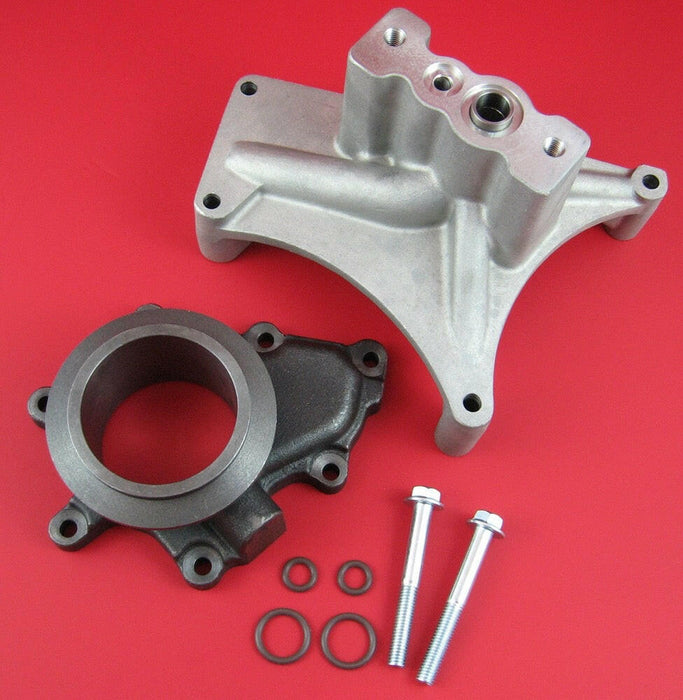

7.3 Powerstroke EBV Delete Kit with Bellowed Up-Pipes - 1999.5-2003 Ford Super Duty
Description
7.3L Powerstroke EBPV Delete Kit - 1999.5-2003 Ford F-250/F-350/F-450
The Powerhouse Diesel 7.3 Powerstroke EBV delete kit removes the factory EBPV (Exhaust Back Pressure Valve) and replaces the stock pedestal with a non-EBPV unit on 1999.5-2003 Ford F-250, F-350, and F-450 Super Duty trucks. The EBPV is a factory-installed valve that restricts exhaust flow to build heat faster during cold starts - on high-mileage trucks it commonly sticks shut under load, causing elevated exhaust gas temperatures, turbo lag, and rough running. No tune is required for the EBPV delete on a stock 7.3L Powerstroke.
What's Included in the EBV Delete Kit
- Non-EBPV pedestal (direct bolt-on replacement for the factory EBPV pedestal)
- Bellowed up-pipes (pair of flexible, stainless-lined up-pipes that replace the factory rigid steel up-pipes)
- Turbo flange and o-ring kit
- Mounting hardware
Factory up-pipes on the 7.3L Powerstroke are rigid steel and prone to cracking at the bellows joint after 100,000+ miles - especially on trucks driven hard or on rough roads. Bellowed (flexible) up-pipes absorb the engine movement and heat cycling that cracks the factory units.
Fitment
Fits 1999.5-2003 Ford F-250 Super Duty, F-350 Super Duty, and F-450 Super Duty with the 7.3L Powerstroke diesel engine. Does not fit early 1999 (pre-August 1999 production) 7.3L Powerstroke trucks or 1994-1998 7.3L trucks.
For more 7.3L Powerstroke upgrades, visit the full 7.3 Powerstroke parts collection.
7.3L FORD Powerstroke EBV Delete Kit
Fits:
3/99 - 2003 7.3L Ford F-Series Powerstroke Diesel
Includes:
- Non-EBP Pedestal
- Non-EBP Turbo Outlet Flange
- Turbo and Pedestal Mounting O-rings (4 pcs)
- Turbo Mounting Bolts (2 pcs)
- stainless uppipes with upgraded bellows
- uppipe hardware to install
What is the Exhaust Back-pressure Valve?
The EBPV valve is designed to close during cold engine operation to allow the engine to warm up quicker by creating additional exhaust backpressure. The system components include a flapper valve in the exhaust outlet housing, which is controlled by an actuator located in the exhaust pedestal. The PCM operates an electric solenoid (also located in the pedestal), which send engine oil pressure to the actuator when EBPV action is desired.
What can go wrong?
As these trucks age, failures of the EBP system are becoming more common. We have seen trucks come in that could hardly move out of their own way because the EBV was rusted in the closed position. Oil leaks from the actuator located in the pedestal are also common. The solenoids also fail or break and are quite expensive.
What is the answer?
Many customers are choosing to remove the EBP system all together for a number of reasons. Some of us just love the beauty of simplicity, others want to cut costs. Still others want to increase performance by removing even the slight restriction of the open valve. Deleting the EBP, will set a code, but will not turn on the check engine light. If you've weighed the pros and cons, and decided deleting is the way to go, this 7.3 Powerstroke EBPV delete kit makes it easy!
Own a 1999 Truck?
If you own a 1999 truck, it is very important to determine if it is an early or late 1999. This product ONLY fits late 1999's. Many 1999 owners have learned the hard way that going by the VIN or production date is not always accurate. The easiest way to quickly determine if your truck is early or late is to measure the diameter of the intake cover connection. Late model trucks have a three inch inlet, early trucks have a two inch inlet. See figure below.
Why Delete the 7.3 Powerstroke EBPV?
The EBPV on the 7.3L Powerstroke is controlled by a solenoid and a vacuum line. When functioning correctly it closes during cold starts to restrict exhaust flow and build cylinder heat faster - useful in sub-zero temperatures. On trucks with over 100,000 miles the solenoid sticks, the vacuum line deteriorates, or the butterfly valve itself seizes in the partially-closed position.
- Hard starting in cold weather (valve stuck partially closed)
- Elevated exhaust gas temperatures (EGTs) under load - stuck valve restricts flow at operating temp
- Turbo lag - back pressure reduces turbo spool-up efficiency
- Rough idle - uneven exhaust flow affects cylinder scavenging at low RPM
Deleting the EBPV with a non-EBPV pedestal eliminates the solenoid, vacuum line, and butterfly valve from the exhaust stream entirely. No tune is needed - the PCM on 1999.5-2003 trucks idles up slightly at cold start as the built-in cold-start compensation, which takes over from the EBPV function.